

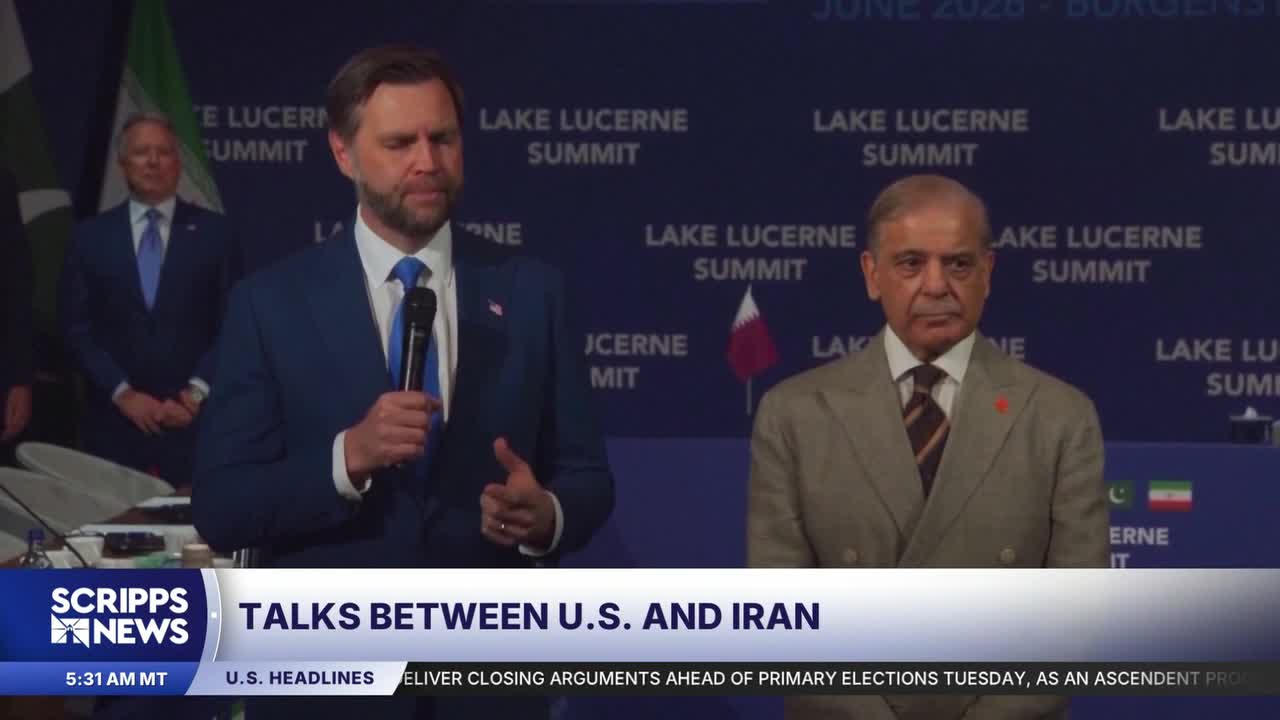


For years, President Donald Trump, Secretary of State Marco Rubio and Vice President JD Vance argued against deals that provided financial concessions to Iran, saying that giving the regime money fuels terror. But now the agreement they’ve reached to end the war with Tehran is poised to hand the regime billions.
For the better part of a decade, Trump’s central indictment of former President Barack Obama’s Iran nuclear deal was simple: Giving Tehran access to frozen assets enriched a dangerous regime and got the United States little in return.
Trump’s current secretary of state and vice president went even further, co-sponsoring legislation as senators that argued Iranian frozen funds could not be safely released because the money, even with rules governing its use, could end up being utilized in a dangerous way.
Now, all three are backing an agreement that spells out US commitments to potentially release those funds and lift sanctions on Tehran but leaves specific details on Iran’s nuclear program to future negotiations.
RELATED STORY | What the Iran war cost the Pentagon, the economy — and Trump
Administration officials have downplayed the significance of the written document and said the movement of any money will be performance-based. They also have said the atmosphere of this deal is different from previous ones because the US has degraded Iran’s military.
“We have great confidence that we’re going to be able to see if they try to fund terrorist organizations,” Vance said Thursday.
However, the signed memorandum of understanding nevertheless embraces the same type of incentivized financial relief that Trump, Rubio and Vance spent years warning would enrich a nation they described as the world’s leading state sponsor of terrorism.
Under the terms of the 14-point memorandum of understanding formally signed and released by the White House on Wednesday, the US “undertakes to make fully available for use the frozen or restricted funds and assets of the Islamic Republic of Iran upon the implementation of this MOU,” “to terminate all types of sanctions against the Islamic Republic of Iran, including the United Nations Security Council resolutions,” and to immediately issue waivers for the sale of Iranian oil.
The Trump administration has vehemently argued that its agreement is stronger than Obama’s Joint Comprehensive Plan of Action, or JCPOA, despite many analysts and critics arguing it appears to give Iran significant concessions.
Significantly, a number of Republican senators, including those who typically stay quiet, have openly questioned the terms of Trump’s Iran negotiations.
Roger Wicker, the chairman of the Senate Armed Services Committee, said he was “concerned that the memorandum of understanding negotiates away the victories” of the war and that the plan for a $300 billion reconstruction fund would make the financial incentives in the JCPOA “look like a pittance by comparison.” The administration said the US would not contribute to that fund.
Trump has long criticized the JCPOA, from which he withdrew the US in 2018, in large part because it gave Tehran sanctions relief and access to frozen assets.
In an op-ed in September 2015 — ahead of the deal’s implementation — then-candidate Trump castigated the JCPOA for the prospect of lifting “all nuclear related sanctions” and handing Iran “a windfall of $150 billion, which will no doubt fund terrorism around the world.”
“It appears we wanted a deal at any cost,” he wrote.
RELATED STORY | Why Trump's blunt talk makes it harder to know how a deal with Iran could go
As recently as 2016, Trump argued that Obama had made a basic mistake by relieving pressure on Tehran before obtaining stronger concessions. “We took the sanctions off, we got nothing for that,” Trump said at a conservative summit in Denver. “It’s like 101, Trump, ‘The Art of the Deal.’”
“Why did Pres Obama remove sanctions against Iran prior to negotiating rather than completing successful negotiation & then remove sanctions?” Trump tweeted in 2014.
Trump also repeatedly argued that giving Iran access to frozen assets made the regime stronger and enriched a government he described as a sponsor of terrorism.
During a 2016 presidential debate, Trump called the Iran deal “a one-sided transaction” in which the United States was “giving back $150 billion to a terrorist state — really the No. 1 terrorist state,” adding that “we’ve made them a strong country from really a very weak country.”
Earlier that year, he told the American Israel Public Affairs Committee that the United States had “rewarded the world’s leading state sponsor of terror with $150 billion and we received absolutely nothing in return.” Trump returned to the theme repeatedly, saying in 2015 on CNN that “we shouldn’t have given their money back” and arguing in 2019 that Obama had “paid $150 billion for a short-term agreement.”
“I would have made a deal not from desperation. I would have doubled and tripled up the sanctions and I would have made a much better deal,” Trump added.
It was not only the current president, but members of his Cabinet who criticized the JCPOA, as well as an agreement under former President Joe Biden that would have given Iran access to $6 billion in frozen assets for humanitarian purchases in exchange for the release of five detained Americans. Those assets were refrozen shortly after the release of the Americans, in response to the October 7, 2023, Hamas attack on Israel.
In September 2015, then-Sen. and presidential candidate Rubio condemned the JCPOA, arguing that “Iran will immediately use the money it is receiving in sanctions relief to begin to build up its conventional capabilities” and that it “will establish the most dominant military power in the region outside of the United States and it will raise the price of us operating in the region.”
That same month, he published a list of “Ten Things That Every American Should Be Concerned About In The Iran Deal.” Four of the points addressed sanctions relief, including the argument that “With Billions in Sanctions Relief, Iran Will Boost Terror and Threaten the Middle East.”
In August 2023, 26 Senate Republicans, including then-Sen. Vance, sent a letter to then-Secretary of State Antony Blinken and then-Treasury Secretary Janet Yellen denouncing the use of the funds in the detainee deal and expressing concern they were “attempting to sidestep Congress and pursue other pathways to financially compensate Iran in an attempt to renegotiate a successor to the ill-fated 2015 nuclear deal.”
“Any agreement with the Iranian regime that entails financial reward for malign behavior is wholly unacceptable,” they wrote.
In December 2023, Vance and Rubio co-sponsored legislation led by Sen. Tim Scott to freeze the Iranian funds in Qatar. That bill argued that “given the fungible nature of money, funds released to Iran for so-called humanitarian purposes cannot be reliably prevented from funding future terrorist attacks, especially when the Government of Iran has explicitly acknowledged their willingness to use any and all monetary gains to support the ideology of their regime.”
A senior administration official said “it would be moronic to compare terms” of the MOU to the legislation sponsored by Vance and Rubio because of the military action against Iran and the conditions on the release of the money. State Department spokesperson Tommy Piggott said that “Rubio and the entire administration is 100% in lockstep behind President Trump.”
In July 2024, just after becoming Trump’s pick for vice president, Vance told Fox News that “if you want to check Iran,” one way to do it is to “withdraw their oil money, which of course, Joe Biden’s been bad about.”
Under Trump’s newly negotiated MOU, the US will immediately issue waivers for the sale of Iranian oil.
The-CNN-Wire™ & © 2026 Cable News Network, Inc., a Warner Bros. Discovery Company. All rights reserved.
